Inflammation Isn’t a Bad Thing, But When It Gets Out of Control, That’s the Real Trouble
May 22, 2026
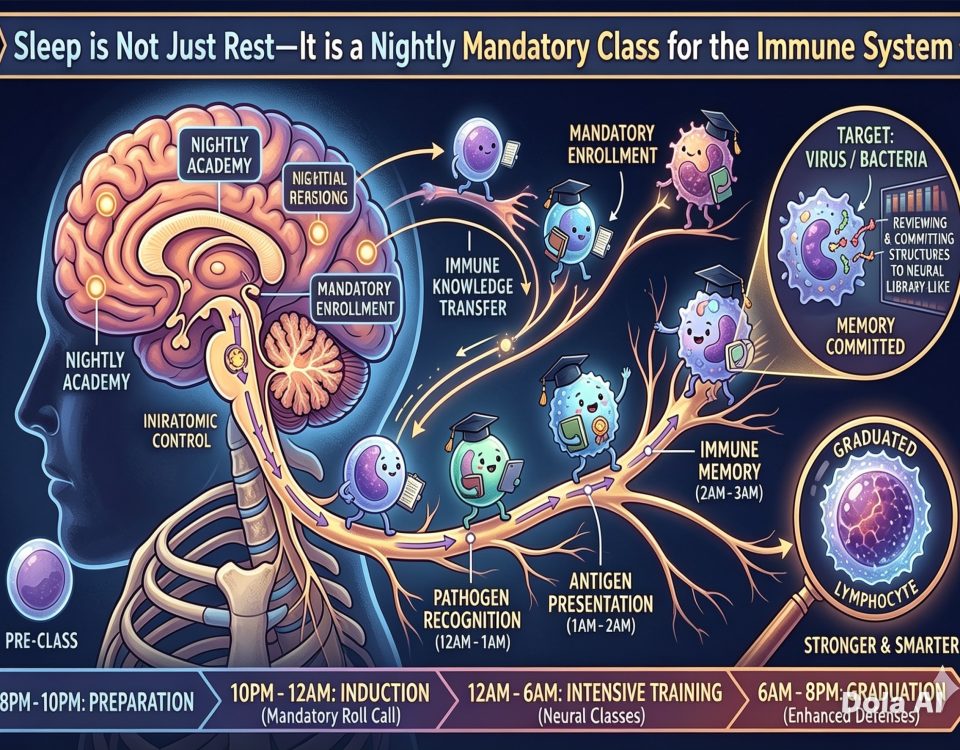
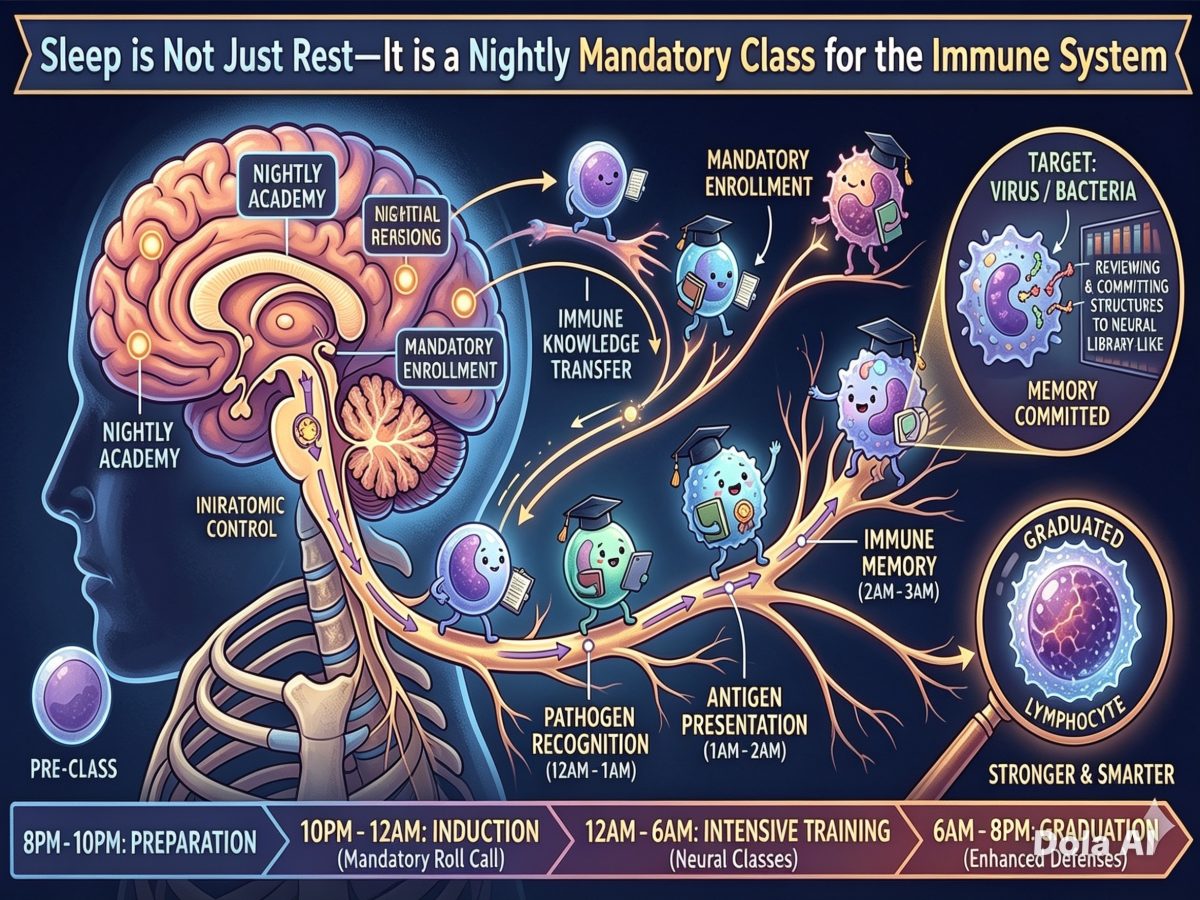
Sleep is Not Just Rest—It is a Nightly Mandatory Class for the Immune System
May 22, 2026High stress isn't just an emotional problem — it directly weakens your immune system
High stress isn't just an emotional problem — it directly weakens your immune system
—— Experiments have dripped cold viruses directly into people's noses, and the results are very clear.
⏱ A One-Minute Read
Have you noticed: before every big exam, before every project deadline, whenever something major happens at home — you catch a cold shortly after?
This is not a coincidence. Long-term psychological stress systematically weakens your immune function through real physiological pathways.
The stress hormone cortisol helps you cope with crises in the short term, but when it remains high for long periods, it dulls immune cells, increases inflammation, and raises infection risk. Carnegie Mellon University once dripped cold viruses directly into people's noses — the greater the stress, the higher the infection rate. This isn't metaphysics; it's a fact backed by experimental data.
The Core Framework: The stress-immune damage chain model
| Core Dimension | Explanation |
|---|---|
| Short-term stress (beneficial) | Cortisol briefly rises → immune system briefly activates → coping with crisis → return to normalr |
| Chronic stress (harmful) | Cortisol remains persistently elevated → immune cells develop resistance to it → pro-inflammation becomes uncontrolled |
| Immune damage outcomes | Declined T cell function, reduced NK cell activity, increased infection risk, weakened vaccine response |
Diagram: Core Mechanism
Stress event → Brain perceives danger → HPA axis activates → Cortisol secretion
↓
Short-term: brief immune activation (beneficial, enables crisis response)
Long-term: systemic immune damage (harmful, difficult to recover quickly)
↓
More infections · Higher inflammation · Weakened vaccines · Immune accelerated aging
Tier 4 | In-Depth Reading
I. That experiment: they dripped the virus directly into people's noses
In 1991, psychologist Sheldon Cohen at Carnegie Mellon University conducted an experiment that would be nearly impossible to get ethics approval for today.
He recruited 276 healthy volunteers and used a detailed psychological scale to carefully assess each person's level of psychological stress over the previous year — work stress, family conflict, financial pressure, major life events — every item precisely quantified. Then, he dripped a common cold virus (rhinovirus) directly into each person's nasal cavity.
After that, all participants lived in a quarantined environment for five days. Researchers tracked their symptoms, nasal secretions, and viral test results daily to determine who actually got sick.
The results were very clear — so clear they were unsettling: the higher the psychological stress score, the higher the infection rate, the more severe the symptoms, and the longer the recovery time. This relationship was linear — for every step increase in stress score, cold severity rose accordingly. The infection rate in the high-stress group was nearly twice that of the low-stress group.
This experiment was published in the New England Journal of Medicine and remains one of the most important foundational studies in the field of psychoneuroimmunology. For the first time, using rigorous experimental data — with viral load measurements, symptom scores, and quarantine controls — it proved something people had intuitively felt but could not prove: psychological state directly affects immune system function.
Not metaphysics, not a psychological effect, not a placebo effect. It is a measurable, reproducible physiological reality in the laboratory.
Cohen later conducted several similar studies, and each time the conclusion pointed in the same direction: the greater the stress, the easier the infection, the slower the recovery.
2. How does stress damage the immune system? The story of the HPA axis
To understand the relationship between stress and immunity, you first need to understand a stress system called the hypothalamic-pituitary-adrenal (HPA) axis.
This system was evolved over millions of years to handle one specific type of stress: acute, physical, short-term danger — like encountering a predator and needing to run immediately.
When the brain perceives danger, the hypothalamus immediately sends a signal, the pituitary gland receives it and secretes ACTH, which travels through the blood to the adrenal glands, triggering a large release of cortisol. Cortisol is an extremely potent stress hormone — within minutes, it mobilizes the body's energy reserves, raises heart rate and blood pressure, suppresses digestion and reproduction (unnecessary when fleeing), and briefly activates the immune system to prepare for possible infection from injury.
This is a perfect design for encountering a predator.
The problem is, modern life stress isn't a predator. Modern stress is deadlines, unpaid mortgages, chronic job insecurity, chronic relationship conflicts, persistent anxiety about the future. The defining feature of this type of stress is: no clear endpoint, no specific target to fight or flee from — it just keeps existing.
The HPA axis doesn't know how to distinguish a predator from a deadline. To it, all threats are threats. So it keeps secreting cortisol, constantly, never stopping.
This is the mechanism of immune damage under chronic stress: cortisol remains persistently elevated, immune cells gradually develop resistance to cortisol signals, and the number of cortisol receptors on immune cell surfaces decreases. Cortisol is normally anti-inflammatory, but once immune cells become resistant to it, pro-inflammatory cytokines begin to be secreted uncontrollably, and chronic inflammation follows.
At the same time, cortisol directly suppresses T cell proliferation and activity, reduces natural killer (NK) cell killing power, and decreases antibody production. Research shows (Psychoneuroendocrinology, 2004) that NK cell activity in chronically stressed populations is about 30% lower than in low-stress control groups, and the number of CD4+ T cells is also significantly reduced. This directly means: when you face an infection, your defenses are weaker; when you encounter cancerous cells, your ability to clear them is lower.
This is not a theory — it is an effect that can be precisely measured in blood tests.
3. Three real consequences of chronic stress — you may already be experiencing them
Understanding the mechanism is important, but what matters more is understanding the real-life manifestations of chronic stress in your daily life. These three consequences — you may already be experiencing them without realizing they are linked to stress.
The first consequence, and the most direct: more frequent infections and slower recovery.
If you have noticed that your number of colds has significantly increased in recent years, or that each cold takes much longer to get over — where it used to take two days, now it drags on for one or two weeks — chronic stress is an explanation worth serious consideration. Many people attribute this to getting older or being too tired lately; both have some truth, but the underlying mechanism is often the persistent depletion of immune function by chronic stress.
There is a very typical pattern that many people have experienced: during a peak stress period (project deadline, year-end push, family crisis), you hold up and don't get sick; but as soon as the stress ends (the project finishes, vacation starts), you collapse instead.
This is called the cortisol withdrawal effect. During the stress period, high cortisol levels temporarily suppress some immune symptoms; once the stress disappears and cortisol drops, the accumulated immune response suddenly erupts — and manifests as a cold. If you often get sick just as you start vacation or just after stress ends, it's not bad timing — it's your immune system telling you how exhausted it has been.
The second consequence: weakened vaccine response.
This is a particularly practical effect. Cohen and his colleagues found that chronically stressed populations (for example, caregivers of Alzheimer's patients) who received flu shots produced significantly lower levels of protective antibodies than low-stress control groups. Same vaccine, same dose, but different stress levels — the protective effect is completely different. This means: if you get vaccinated during a long period of chronic stress, the protection you receive may be far less adequate than you think.
The third consequence: accelerated immune aging — this is the most profound and least discussed effect.
A study by Elissa Epel and colleagues published in the Proceedings of the National Academy of Sciences in 2004 found that mothers who had been caring for a chronically ill child for a long time (a chronically high-stress group) had significantly shorter immune cell telomere length (telomeres are a key measure of cellular aging) compared to low-stress controls of the same age — equivalent to the biological age of their immune cells being about 9 to 17 years older.
Chronic stress doesn't just make you catch more colds now — it accelerates your immune aging at the cellular level.
4. Stress Management is Not a "Soft Skill"—It is True Immunological Intervention
Many people view stress management as a kind of mental hygiene, believing it is unrelated to real health management — the former is soft, subjective, optional; the latter is hard, scientific, essential.
This division is biologically wrong.
Stress management is an immune protection strategy — just like sleep, exercise, and diet — with measurable physiological effects. The following interventions have been shown in rigorous randomized controlled trials to protect against stress-related immune damage.
Mindfulness-Based Stress Reduction (MBSR). A 2016 meta-analysis published in Psychoneuroendocrinology, synthesizing data from 18 studies, found that an 8-week MBSR course significantly reduced cortisol levels while improving NK cell activity and CD4+ T cell function. This isn't just feeling more relaxed — it is an improvement in immune function that can be measured in blood tests. You don't need to become a meditation master; just 10 to 20 minutes of basic mindfulness practice per day is already effective.
Regular aerobic exercise. Exercise itself is a controllable form of stress — it activates the HPA axis, briefly raises cortisol, and then quickly returns to normal. This repeated cycle of activation and recovery trains the HPA axis to be more resilient and recover faster, while also directly training the immune system to handle states of stress. One hundred fifty minutes of moderate-intensity exercise per week is currently the single most evidence-supported intervention against chronic stress-induced immune damage.
High-quality social support. Loneliness and social isolation have been shown to be health risk factors on par with smoking (Holt-Lunstad et al., 2015). People with high-quality social support, even under high stress, show significantly less damage to immune cell function than socially isolated individuals — social connection protects immune function by regulating cortisol levels and activating positive emotions.
Sleep protection. This may be the most easily overlooked: during stress, sleep is often the first thing sacrificed — working late into the night, insomnia caused by anxiety. But this is precisely when sleep is most important, because during deep sleep, cortisol drops to its lowest point of the day — the only window for the immune system to recover from stress-induced damage. Protecting sleep is not just resting; it is actively repairing stress-related immune damage.
For people over 40, chronic stress is one of the most underestimated factors damaging immunity. Before considering what supplements to buy or what antioxidant foods to eat, first seriously assess your own chronic stress level — that may be the biggest vulnerability in your immune system.
5. Identify your own chronic stress pattern
Chronic stress has a particularly insidious characteristic: many people stay in chronic stress for so long that they start to think it's normal — and even feel that something is wrong when there is no stress.
The following questions can help you assess whether you are in a state of chronic stress that is harmful to your immune system.
Do you find it genuinely difficult to truly relax? Even during rest or vacation, there is always a background sense of tension, unable to fully switch into relaxation mode. This is a sign of persistent HPA axis activation.
Is your sleep chronically affected? Difficulty falling asleep, early waking, light sleep — these are often signs of disrupted cortisol rhythm due to chronic stress (cortisol should drop at night, but it doesn't).
Do you often feel "burned out" — not physically tired, but an emotional and psychological sense of exhaustion? This is called chronic stress-related fatigue, and it is a different experience from fatigue caused purely by sleep deprivation.
Does your digestive system often feel uncomfortable? The gut and the brain's stress system are bidirectional — chronic stress directly affects gut microbiota composition and gut function, leading to chronic digestive discomfort.
If several of the above apply to you, you may already be in a state of chronic stress that causes substantial damage to your immune system — and it's not just "being a bit busy lately." This recognition itself is important, because only by acknowledging the problem can you begin to address it.
Key Takeaways
-
The direct intranasal virus experiment at Carnegie Mellon University proved directly: the greater the psychological stress, the higher the probability of infection with the common cold virus, the more severe the symptoms, and the slower the recovery. This is laboratory data, not a feeling.
-
The HPA axis and cortisol are the specific physiological pathways through which stress damages immunity. Chronic stress leads to persistently elevated cortisol, immune cells develop resistance to it, NK cell activity drops by 30%, and T cell function is significantly weakened.
-
Three real-world consequences: increased frequency of infections (including the cortisol withdrawal effect after stress ends), weakened vaccine response (poorer protection from the same vaccine), and accelerated aging of immune cells (biological age 9–17 years older).
-
Mindfulness-Based Stress Reduction (MBSR), regular aerobic exercise, and high-quality social support are currently the three most evidence-supported interventions for stress-related immune protection — their effects can be measured in blood tests.
-
After age 40, chronic stress is the most underestimated factor damaging immunity — before considering any supplements, first seriously assess and address your own level of chronic stress, because that is likely the biggest vulnerability.
FAQ | Questions You're Most Likely to Ask
Core Sources Cited
- Cohen S et al. (1991). Psychological stress and susceptibility to the common cold. NEJM, 325, 606-612. https://doi.org/10.1056/NEJM199108293250903
- Segerstrom SC & Miller GE. (2004). Psychological stress and the human immune system. Psychological Bulletin, 130(4), 601-630. https://doi.org/10.1037/0033-2909.130.4.601
- Epel ES et al. (2004). Accelerated telomere shortening in response to life stress. PNAS, 101(49), 17312-17315. https://doi.org/10.1073/pnas.0407162101
- Holt-Lunstad J et al. (2015). Loneliness and social isolation as risk factors for mortality. Perspectives on Psychological Science, 10(2), 227-237. https://doi.org/10.1177/1745691614568352